
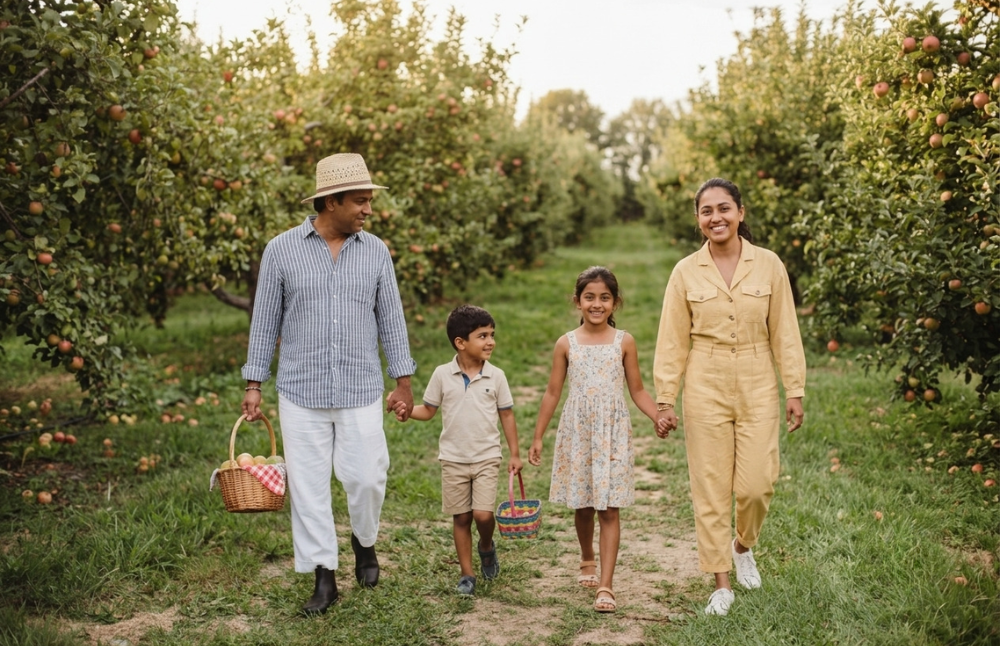
What Your Children Will Remember About Weekends
Childhood doesn’t remember everything. It curates.Decades from now, your children won’t remember the Netflix series they watched or the restaurant you took them to. They won’t remember most of what you bought them. Memory, for children, works on a different principle — it keeps the sensory, the spatial, the genuinely felt.It keeps places.Not every place. The ones that mattered. The ones where something was different about how time moved. The ones where they were fully, completely themselves — not watched, not managed, not scheduled.The question worth asking, then, is this: What places are you giving them?
What the City Cannot Provide
Cities are extraordinary for children in many ways. Culture, exposure, diversity, opportunity — these things matter, and urban childhood has real advantages.But there are things a city structurally cannot offer.Room to run without hitting a wall. Darkness dark enough to see the stars. Soil that you can actually put your hands into. The experience of growing something and watching it become food. An afternoon with no particular structure, no particular destination, and no particular end time. These things require space. And space is the one resource that cities ration most ruthlessly.
What Farm Weekends Build
Children who spend regular time in natural, farm-based environments develop differently in specific, documented ways. They are better at unstructured play — the ability to create their own games, occupy themselves without external input, and tolerate boredom long enough to discover something interesting on the other side of it. They have stronger observational skills. They notice things. They ask more questions. They are, on average, calmer — with lower baseline anxiety and more resilience to stress. Not because nature is magic, but because they’ve spent time in environments that don’t demand constant responsiveness. They also develop a relationship with food that city children rarely have: they know where it comes from. They’ve grown it, picked it, eaten it the same day. This is not nostalgia for a simpler time. These are genuine developmental advantages, and they compound.
A Day Through Their Eyes
What does a day at Foresight Farms look like for your child? It might start at the kids play area — proper outdoor equipment, space to run, other children to discover. By mid-morning they’ve wandered to the kids garden, where they’ve planted something small and are already checking if it’s grown (it hasn’t yet, but they’ll be back to look). After lunch, someone organises an informal cricket match on the ground. Your child — who has never had space for a real cricket match — discovers they’re quite good. Or quite bad, and laughs about it, which might be better. The afternoon involves a cycling loop, a detour through the rose garden, and an extended conversation with a neighbour’s child about something neither of you understood fully but both found deeply compelling. And then the campfire. The stars. The realisation, sometime around 9pm, that they haven’t asked for a screen in seven hours. You note this quietly. You say nothing. You don’t want to jinx it.
What They’ll Say When They’re Grown
Ask people in their 30s and 40s what they remember about childhood. Ask specifically about the places that shaped them. Almost always, those places are outdoors. Almost always, they involve some combination of space, freedom, and the absence of adult agenda. Almost always, they involve the natural world in some form — a garden, a farm, a field, a river. The people who had those places are the people who know, instinctively, what it means to be rooted somewhere. That is the gift of land. Not the asset appreciation (though that matters). Not the legal documentation (though that’s essential). The gift of land is a place — for your children, and your children’s children — to know what it feels like to belong somewhere. At Foresight Farms, plots are available from 2,000 to 22,000 sq.ft in Vikramgad, Palghar. One hour from Mumbai. Fully infrastructured. Deeply peaceful. Nature, rooted here. Visit foresightfarms.in or contact our team for a site visit.